"In yet another departure, McGinley has incorporated black-and-white and color studio portraits of nudes and animals interacting in sometimes sweet, sometimes surprising ways. The use of animals is another facet of McGinley’s exploration of the natural world. They bring out the animalistic qualities of the nude figure, and the scratches on the bodies signify our desire to commune with nature and the excitement and risks inherent therein."
Ola Rindal, Born in Norway, is a photographer now living and working in Paris. She studied film and photography, and has participated in numerous exhibitions.
"For if the moment of an action always shows something caught on-the-spot, Rindal’s photos are essentially such that some kind of double-trigger effect takes place. Although the subjects stand “rooted to the ground”, they somehow look as if they were floating within rather indeterminate ambiances, ambivalent situations seemingly stock-still and yet hovering. As a result, one’s visual impression is kept insecure, as nothing appears to be really assured." Frédéric BONNET, For Galerie Catherine Bastide, 2010
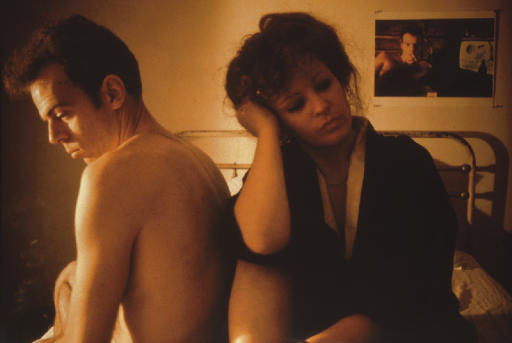
Last Sunday I read an article in Maison & Decoration about Rebecca Camhi, a gallery owner in Greece, and the exhibition of Nan Goldin's photography. There was only one tiny photo of Nan Goldin's work because the article was about the gallery owner, but I felt that something clicked and I had to know more about her. I was really moved by her work and by the way she explains what her photographs are about.
Nan Goldin started taking pictures at the age of 15 and later on in the early 70's she was introduced by a friend to drag queens and started living with them and documenting their lives. Additionally she took photos of her friends at clubs and at private moments as well as self portraits. As she states she wanted to make a record of real life because she knew from a very early age that what she saw on television had nothing to with real life. Nan Goldin says that her work has always been misunderstood of being about drugs and parties and the underground but she explains that it was never about that, it was about the condition of being humanand the pain and the ability to survive and how difficult that is.
"I think what I like about being an artist... is the freedom to investigate anything I feel, at any time, in any way. I'm not formally trained, so I don't have any preconceptions as to how I should or shouldn't go about doing something." Philip Tsiaras
The Thessaloniki Museum Of Photography presents the first exhibition in Greece of the international artist Philip Tsiaras. Displayed at the exhibition will stand more than 200 selected works of the artist, covering his whole photographic output from 1971 to date.Until December 6 2009.
Philip Tsiaras (b. 1952) is an international artist of Greek origin, who lives and works in New York City. Tsiaras works in a great range of media–painting, photography, glass, ceramic, and bronze. He has exhibited in the Venice Biennale three times and produced a ten foot bronze sculpture on the Grand Canal entitled “Social Climber”.Since 1974 he made more than 75 one-person exhibitions.
Robert Piguet, Raphaël, Pierre Balmain Balenciaga David Seidner: Paris Fashions, 1945 Back in 1944, the war-battered French couture industry decided to revive its international reputation by conceiving a small exhibition entitled Théâtre de la Mode. The exhibition organizer enlisted the major fashion designers of the day, including Jeanne Lanvin, Lucien Lelong, Elsa Schiaparelli, and Pierre Balmain to create outfits for small wire-frame dolls just over two feet tall.
Lucien Lelong
The exhibition of over 230 dolls, displayed in artist-designed sets, opened in Paris on March 27, 1945 at the Museum of Decorative Arts. It was an instant sensation, and traveled to London, Barcelona, Copenhagen, Stockholm, Vienna, New York, and San Francisco. With the return of the French fashion industry, the dolls had completed their work and were donated to the Maryhill Museum near Portland, Oregon, where they disappeared from view.
Marcel Dhorme
Under an extraordinary set of circumstances in 1990, the dolls were rediscovered and returned to Paris, recoiffed and restyled for an exhibition at the Musée de la Mode. Because of his pioneering work with French fashion and historical gowns, David Seidner was asked to photograph the little dolls. Working in the rough interior of an abandoned theatre set, Seidner captured the essence of French style in dolls dressed in designs made on the eve of Christian Dior's New Look, which radically changed fashion in 1947. ICP will exhibit fifteen of Seidner's color photographs from the David Seidner Archive in the Permanent Collection, along with one of the original dolls. Jean Patou "Fleurs de Mal"
Lucien Hervé was a French-Hungarian photographer well known for his black and white photos of architecture. His collaboration with the infamous Le Corbusier had such an effect on the latter, that resulted in the re-drawing of some of his original plans. Hervé had shown Le Corbusier a completely different view through his photographs. He wrote to Hervé pronouncing him to have "the soul of an architect". Hervéalsocollaborated with numerous architects and took photos of modern architecture buildings as well as archeological monuments. His last work consists of photographs of his apartment in Paris.
It's an image from Alinka Echeverria'sphotography and film, titled "The lightness of being". Alinka Echeverria shoots underwater images taken from a different angle. Take a few minutes and watch"The lightness of being" videofound at Alinka Echeverria'ssite. You won't regret it! Many thanks to Anthony Tammaro for tweeting this (via NOTCOT.)






 Robert Piguet, Raphaël, Pierre Balmain
 Balenciaga
 Lucien Lelong
 Marcel Dhorme
 Jean Patou "Fleurs de Mal"